What Changed When AI Learned to Read the Shape of Proteins
Why protein-structure prediction challenged scientists for decades, and how it became a defining advance in computational biology.
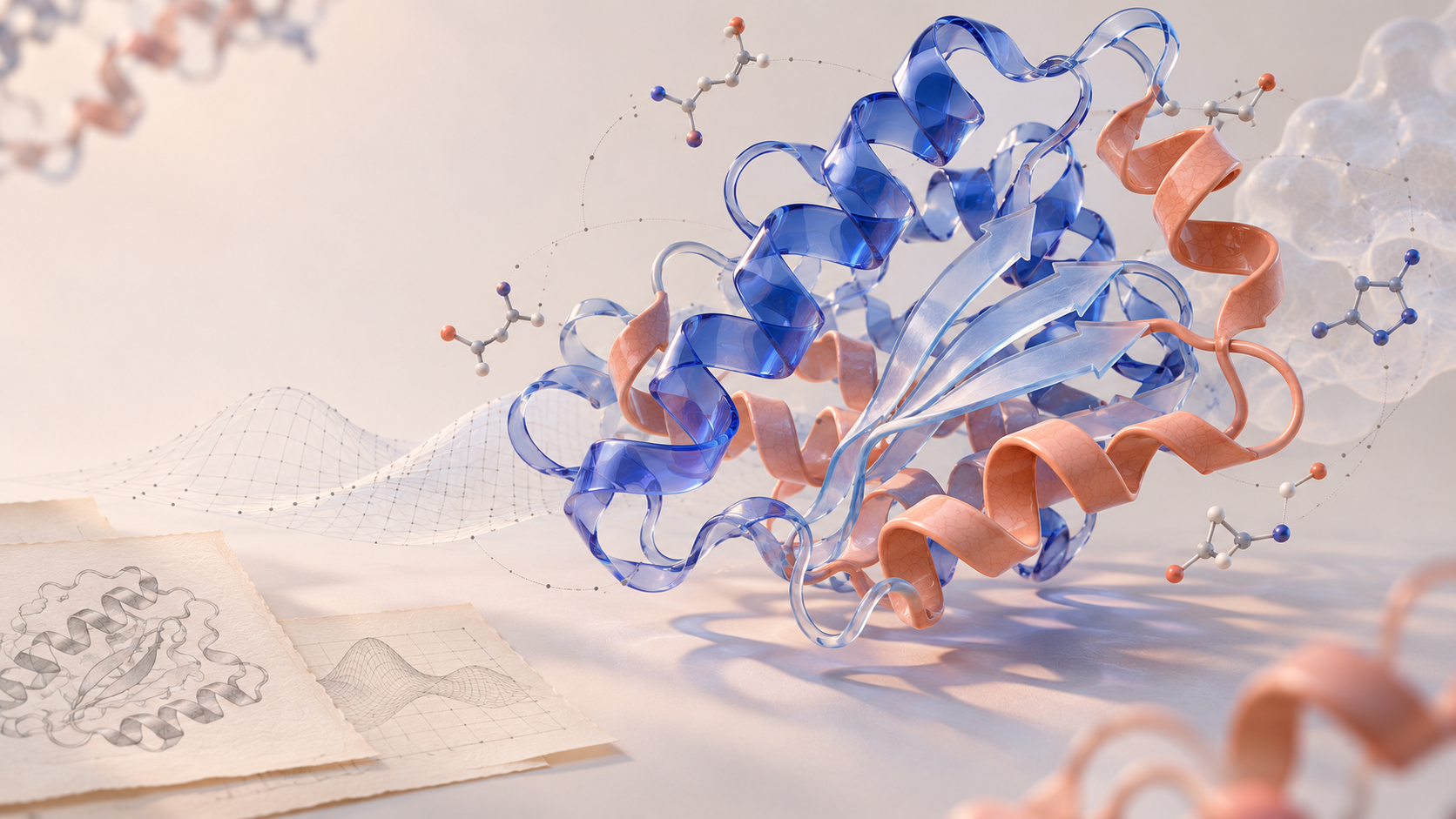
Proteins are chains of amino acids that fold into intricate three-dimensional structures. Shape helps determine function: a protein may act as an enzyme, antibody, hormone, or structural building block. Knowing the sequence alone is not the same as understanding how the protein works.
A problem that lasted half a century
Since the 1970s, researchers have tried to predict protein structures from amino-acid sequences. The problem is difficult because the number of possible conformations is enormous, while subtle structural changes can alter a protein’s behavior.
In 2020, AlphaFold2, developed by Demis Hassabis and John Jumper, marked a breakthrough. According to the Nobel Prize’s official account, the model enabled predictions for virtually all of the roughly 200 million proteins researchers had identified and has been used by more than two million people across 190 countries.
Why structure prediction matters
Structure is an entry point to function. Researchers can use it to investigate antibiotic resistance, examine enzymes capable of breaking down plastic, and propose experimental hypotheses more quickly. Prediction does not replace laboratory work; it changes where experiments begin and what scientists choose to test first.
From predicting nature to designing new possibilities
The other half of the 2024 Nobel Prize in Chemistry went to David Baker for computational protein design. Prediction asks what structure follows from a sequence. Design reverses the question, looking for new structures and sequences that could perform a desired function. The Nobel committee highlighted possible applications in pharmaceuticals, vaccines, nanomaterials, and tiny sensors.
Together, these developments show that AI’s value in science extends beyond generating text and images. A deeper shift occurs when a biological search space that is difficult to explore directly becomes a problem that can be computed, filtered, and experimentally tested.
What still cannot be skipped
A predicted structure must still be interpreted alongside experimental evidence, environmental conditions, and biological mechanisms. A high-confidence prediction is not an approved drug, and it does not prove clinical effectiveness. AI can shorten the path of exploration, but it does not eliminate scientific validation.
Source: The Nobel Prize in Chemistry 2024 — official press release. This article is an independent editorial synthesis.